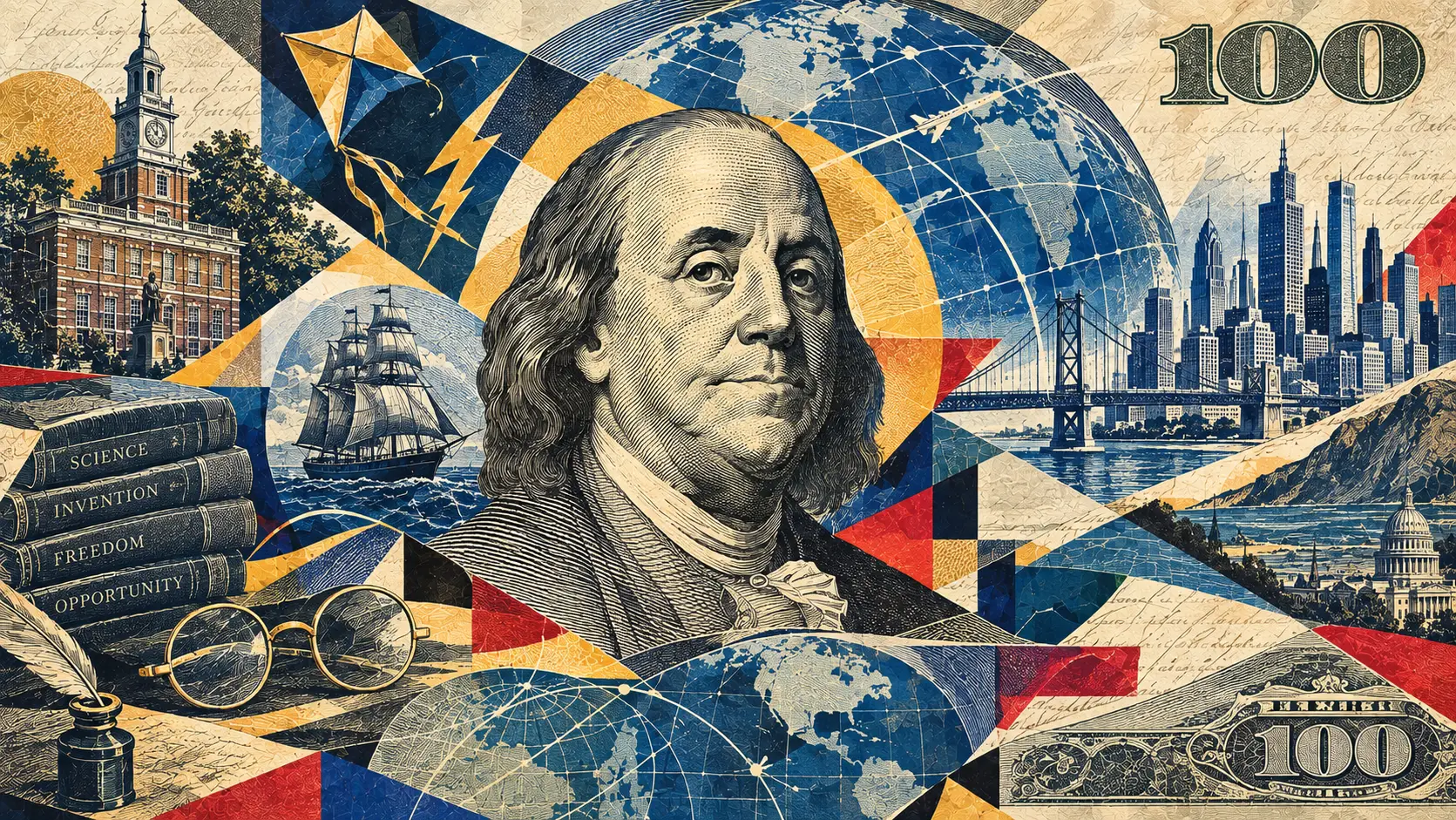

America was built by people who crossed an ocean, a frontier, a border, or an old identity. Now, as Americans themselves increasingly build lives elsewhere, the country’s oldest instinct may be becoming a global one.
At an airport, the most revealing object is not the airplane.
It is the passport.
A passport is a strange little book: several dozen pages designed to record the places where a person has not belonged long enough to need another kind of document. It is proof of nationality, but its real function is to permit temporary disobedience to geography. It allows a person to leave.
At an international departure gate in Los Angeles, Manila, Singapore, or London, the ritual is almost comically mundane. Shoes come off. Bags are opened. A passport is scanned. Someone in a uniform looks briefly at your face and then at a screen. A green light appears. You proceed toward the aircraft.
Yet the entire modern world of mobility is contained in that tiny transaction. A border has been crossed without a war, an army, or a declaration of independence. One person has simply decided to spend some portion of life somewhere else.
For Americans, there is something almost historically appropriate about this.
The United States is usually described as a nation of immigrants, which is true but insufficient. Immigration explains who came to America. It does not quite explain the peculiar cultural power America has given to the act of leaving, starting over, moving somewhere new, and imagining that one’s circumstances need not be permanent.
The deeper American story is not simply about immigration.
It is about reinvention.
For centuries, people have arrived in America because they wanted another life. Some came because they had no choice. Some came because they were poor, persecuted, ambitious, curious, religious, restless, desperate, or simply young. Some were carried across the Atlantic against their will. Others bought a ticket and crossed willingly. Some found freedom. Others found exploitation. Some found wealth. Others found hunger. Some became Americans. Some were never permitted to become Americans at all.
The contradictions are essential.
America’s mythology has always been more generous than its history.
But the mythology itself matters. It produced an unusually powerful idea: that a person might not be permanently defined by the place from which he came.
That idea may now be escaping America.
The contemporary American who moves to Mexico City, Lisbon, Manila, Tokyo, Singapore, or Paris is not an immigrant in the historical sense, at least not necessarily. He may have a U.S. passport, a remote job, a brokerage account, a house somewhere in California, and a return flight already booked. His reasons may be entirely different from those of the Irish laborer arriving in New York in 1850.
But psychologically, there can be an unmistakable resemblance.
Both have looked at the familiar world and asked a dangerous question:
What if my life could work somewhere else?
That question has been one of America’s great engines.
And perhaps, in the twenty-first century, it is becoming an engine for the rest of the world.
Long before there was an American Dream, there were civilizations.
This is an important place to begin because the American story has too often been told as if the continent were an empty stage waiting for Europeans to discover it. It was not. Indigenous societies across North America had developed sophisticated political systems, agricultural practices, trade networks, religious traditions, cities, and relationships to the land long before European settlement.
The first lesson of American mobility, therefore, is that movement is not the same thing as discovery.
The continent was already inhabited.
European colonization brought something else: an enormous movement of people, capital, religion, violence, agricultural systems, commodities, diseases, and political institutions across the Atlantic. The consequences were catastrophic for Indigenous populations and transformative for the world.
Among the settlers were people whose motives were not reducible to economics. Religious communities attempted to build societies according to their convictions. Colonists imagined that distance from Europe might allow different forms of political and religious life. Others were pursuing land, trade, status, or survival.
The Atlantic was not merely a body of water.
It was an escape route.
This is one of the oldest facts about America: geography was part of the ideology.
The ocean created distance from the old world. Distance created room for experimentation. And experimentation created the possibility of a new identity.
The famous American instinct to “start over” therefore predates the United States itself.
It was already present in the decision to cross.
In 1776, the Americans did something remarkable.
They stopped being British.
The Declaration of Independence was, among other things, a declaration of separation. Its authors were not merely proposing a new government; they were announcing that an existing relationship had become intolerable and that political identity could be changed.
The language was universal enough to become larger than the particular dispute that produced it. The Declaration announced rights to “Life, Liberty and the pursuit of Happiness” and asserted that governments derived their legitimate powers from the governed. (National Archives)
There is an expat idea hiding inside this revolutionary document.
Not literally, of course. The colonists were not digital nomads with coworking memberships and carry-on luggage. But the Declaration contains a radical proposition about identity: allegiance is not necessarily permanent. A political relationship can be reconsidered. A person can belong to something new.
The Declaration’s own language described the necessity of dissolving political bands with another country. Congress had voted for independence on July 2, 1776; the Declaration followed two days later, with the parchment signed beginning on August 2. (National Archives)
America’s founding myth therefore begins not with settling down but with breaking away.
This is easy to overlook because modern nationalism tends to emphasize belonging. Americans celebrate the flag, the anthem, the Constitution, the Fourth of July. But underneath these symbols is a peculiar act of refusal.
We will not remain what we were.
That sentence has echoed through American culture ever since.
Then came the frontier.
The frontier was a physical place, but it eventually became something more important: a psychological technology.
Go west.
The instruction appears repeatedly in American history, whether whispered by a farmer considering cheap land, shouted by a promoter selling a railroad town, or embodied by a family loading its belongings into a wagon.
The frontier offered one of the most seductive propositions ever made by a civilization:
There is another place.
And perhaps you can become another person there.
This is what makes the frontier so relevant to the modern expat. A frontier is not simply somewhere with fewer people. It is somewhere in which the existing rules appear less settled.
Your reputation may not travel with you.
Your social class may be less obvious.
Your old failures may be unknown.
The people around you may not know who you were.
That can be terrifying.
It can also be liberating.
The American frontier transformed geography into a form of social mobility. Land could be opportunity. Distance could be reinvention. Movement could become a strategy.
The mythology eventually became so powerful that America developed a peculiar suspicion of staying put.
The ambitious person moved.
The restless person moved.
The entrepreneur moved.
The family looking for something better moved.
The person who had failed in one town could try again in another.
There was always another horizon.
This was not freedom for everyone. The westward expansion of the United States was inseparable from the dispossession of Indigenous peoples, warfare, slavery, and enormous violence. The frontier’s promise depended in many cases upon somebody else’s loss.
That contradiction should not be polished away.
The American idea of mobility has always had a dark side: the freedom to move can be experienced very differently by the person arriving and the person being displaced.
Still, the cultural idea survived.
America became a place where changing location could mean changing destiny.
The nineteenth century turned that idea into mass migration.
People came through ports carrying luggage that seems almost absurdly small by contemporary standards. Their possessions had to fit into trunks, cases, bundles, or whatever they could carry.
They brought recipes.
Religious practices.
Languages.
Photographs.
Names.
Memories.
They also brought the expectation that something might be different here.
By the late nineteenth and early twentieth centuries, New York had become one of the great arrival cities of the world. Ellis Island became a physical symbol of the immigrant experience, but the deeper story happened after the inspection table.
It happened on streets.
In tenements.
In workshops.
In synagogues and churches.
In restaurants.
In boarding houses.
In neighborhood shops where the sign outside might be in English and the conversation inside might not be.
The American city was an enormous machine for turning strangers into neighbors.
That process was neither smooth nor benign. Immigrants encountered prejudice, exploitation, overcrowding, political hostility, and pressure to assimilate. America repeatedly welcomed newcomers while simultaneously debating whether there were too many of them.
This contradiction remains familiar.
A country can celebrate immigration in principle while distrusting immigrants in practice.
A city can depend economically upon foreigners while treating them as outsiders.
A society can benefit from cultural diversity while demanding cultural conformity.
The immigrant therefore lived with a strange question:
How much of yourself should you keep?
And how much must you change to belong?
That is not exclusively an immigrant question.
It is also the question every long-term expat eventually confronts.
There is a moment, somewhere between being a visitor and becoming a resident, when a foreign country stops looking like a backdrop.
The airport becomes familiar.
You know which taxi queue to use.
You have a preferred grocery store.
You recognize the traffic pattern.
You know which café has reliable Wi-Fi and which one has better coffee.
You complain about the weather.
You develop opinions about neighborhoods.
You learn which streets flood.
You discover the restaurant that does not appear in guidebooks.
You acquire a local irritation.
This is the point at which tourism ends.
A tourist consumes a place.
An expat negotiates with it.
That negotiation is where the American immigrant tradition becomes particularly relevant. The immigrant did not merely admire America. He had to figure out how America worked.
The same is true for anyone who actually lives abroad.
The romantic version of expatriation is a photograph of a laptop beside a swimming pool.
The real version is discovering how to open a bank account.
It is understanding the school system.
It is finding a doctor.
It is learning what “tomorrow” means in a particular bureaucracy.
It is figuring out whether an apartment’s advertised square footage can be trusted.
It is discovering that the neighborhood you loved on vacation has a garbage collection schedule.
Living abroad is not tourism with better weather.
It is participation.
And participation changes the person doing it.
One of America’s most revealing historical episodes was the California Gold Rush.
In 1848, gold was discovered at Sutter’s Mill. News traveled rapidly, and people from around the world began heading toward California.
The resulting migration was extraordinary.
People abandoned jobs, farms, businesses, families, and predictable lives in pursuit of a possibility that existed somewhere thousands of miles away.
The Gold Rush was not simply an American phenomenon. It was international.
The world came looking for California.
This is perhaps the most recognizable form of the American Dream: the belief that extraordinary opportunity might exist somewhere else.
But notice the psychology.
The gold itself was almost secondary.
What mattered was the possibility.
Most people would not become fabulously wealthy. Many would lose money. Some would die. Others would build businesses around the miners rather than mining themselves. Cities would emerge. Infrastructure would follow. California would be transformed.
The important thing was that people were willing to move before they knew the outcome.
That is one of the defining characteristics of entrepreneurial cultures.
You go because you think something might happen.
You do not go because you know it will.
This is where the American entrepreneurial tradition and the expat tradition begin to overlap.
Entrepreneurship is often described as the willingness to take financial risk.
Mobility is the willingness to take geographic risk.
Both involve uncertainty.
Both require abandoning some amount of predictability.
Both can produce disproportionate rewards.
And both are easier when failure does not permanently destroy your identity.
America became unusually good at this.
Its cities absorbed people who had failed elsewhere. Its universities attracted outsiders. Its companies recruited immigrants. Its industries constantly created new occupations and markets.
The country developed an extraordinary capacity to make outsiders useful.
Sometimes this was because America was generous.
Sometimes it was because America was hungry.
A rapidly expanding economy needed workers, engineers, scientists, inventors, merchants, artists, doctors, builders, and entrepreneurs.
The stranger was not merely a stranger.
He might be talent.
That distinction matters.
The world’s great cities have always understood this instinctively. Venice, Constantinople, Amsterdam, London, New York, Hong Kong, Singapore, Los Angeles: commercial cities tend to become places where outsiders are disproportionately visible.
A city with no strangers is usually not a great trading city.
Commerce requires people who are willing to cross boundaries.
And boundaries, once crossed often enough, become less intimidating.
The twentieth century industrialized American mobility.
The automobile transformed the relationship between people and distance. The highway system transformed it again.
The American road trip became almost a secular pilgrimage.
You could leave New York and drive west.
You could leave Los Angeles and drive east.
The road did not merely connect destinations. It offered the possibility that your life could be somewhere other than where you had started it.
America’s suburban ideal eventually created another version of the dream: a house, a garage, a lawn, a car, a stable job, a family.
This was often presented as the opposite of mobility.
In reality, it depended upon mobility.
The suburban family could live farther from work because the car made distance manageable. Businesses could relocate. Workers could commute. Families could move from city to suburb. Consumers could cross metropolitan regions in an afternoon.
The American home was increasingly connected to a national transportation network.
Even settled life was mobile underneath.
The postwar American Dream therefore contained an interesting paradox.
It promised stability by making movement easier.
Then America began exporting itself.
Hollywood made Los Angeles recognizable before most people ever visited it.
Jazz and rock and roll crossed oceans.
American universities became destinations for international students.
American corporations established offices around the world.
McDonald’s appeared in countries where hamburgers had never been part of the local culinary imagination.
Blue jeans became universal.
So did Coca-Cola.
Then came Apple.
Microsoft.
Nike.
Disney.
CNN.
The internet.
The American cultural product became portable.
And something subtle happened.
People no longer needed to come to America to encounter America.
They could encounter American music in Lagos, American films in Manila, American software in Bangalore, American business schools in Paris, American fashion in Tokyo.
America had begun teaching the world how to live with a certain kind of cultural permeability.
The country’s most successful exports were often not objects.
They were habits.
The idea that a teenager in Seoul could listen to the same song as a teenager in Chicago.
That an entrepreneur in Nairobi could build a company using American software.
That a student in Shanghai could apply to an American university.
That a programmer in Buenos Aires could work for an American company without ever setting foot in the United States.
Geography was losing its monopoly.
Silicon Valley accelerated the process.
Its most consequential idea may not have been the personal computer or the smartphone.
It was that talent and capital could reorganize themselves around opportunity at extraordinary speed.
The Valley became a peculiar modern frontier.
There were no buffalo.
There were venture capitalists.
There were no covered wagons.
There were Teslas and leased BMWs.
But psychologically the frontier remained recognizable.
People arrived from somewhere else because something might happen there.
And Silicon Valley became extraordinarily dependent upon people who had come from somewhere else.
The immigrant engineer became one of the defining figures of American technological power.
The entrepreneur might be born in India, educated in the United States, employ programmers in Poland, manufacture in Taiwan, incorporate in Delaware, raise money in California, and sell to customers in fifty countries.
The company itself became an expatriate.
It belonged everywhere and nowhere.
The internet made this possible at a scale the nineteenth-century immigrant could not have imagined.
A person’s economic life could now be distributed across borders.
Then COVID-19 demonstrated something that had previously seemed implausible.
Millions of people discovered that their work was less geographically fixed than they had assumed.
The office became a laptop.
The commute became a Wi-Fi connection.
The border, for certain categories of workers, became less relevant to employment than it had been for generations.
The digital nomad was born into popular consciousness.
But the digital nomad did not emerge from nowhere.
He was the latest expression of a much older American fantasy:
If opportunity is not where I am, perhaps I should move.
There is, however, a crucial difference between the nineteenth-century immigrant and the twenty-first-century expat.
The immigrant often moved because he had to.
The expat often moves because he can.
That distinction is morally and politically important.
A refugee does not choose exile in the same way a retiree chooses Portugal.
A family fleeing war is not experiencing the same phenomenon as a software engineer spending six months in Thailand.
A farm worker crossing a border for employment is not equivalent to a wealthy investor purchasing an apartment in another country.
A colonial administrator, military officer, or corporate executive living overseas historically occupied a different position from the people whose land and labor sustained the system around him.
“Expat” is therefore a slippery word.
Sometimes it is simply a more flattering word for immigrant.
Sometimes it denotes a genuine difference in legal status, economic position, or intended duration.
And sometimes it is a social class marker.
The language matters because mobility is not distributed equally.
A wealthy person’s passport can function almost like a key.
A poor person’s passport can function like a locked door.
For one traveler, a border is a minor inconvenience.
For another, it is the defining fact of life.
The freedom to leave is itself a form of privilege.
That may become one of the great inequalities of the twenty-first century.
Not simply who has money.
But who has options.
Consider the modern American sitting in a café in Manila.
His laptop contains an American company.
His phone contains American software.
His bank account is denominated in dollars.
His parents live in California.
His wife may be Filipino.
His children may speak two languages.
His apartment overlooks a neighborhood that his grandparents could not have located on a map.
He orders breakfast in English and perhaps Tagalog. He pays electronically. He follows American news. He watches a Japanese television series. He works with someone in Singapore. He books a flight to Los Angeles for Christmas.
What country is his life in?
The question becomes increasingly difficult to answer.
For much of modern history, nationality, residence, employment, family, language, and culture tended to cluster together.
You were born somewhere.
You grew up there.
You worked there.
You married someone from there.
You raised your children there.
You died there.
The contemporary expat can separate these things.
Birthplace can become biography rather than destiny.
Residence can become a choice.
Employment can become placeless.
Family can become transnational.
Identity can become layered.
This is not entirely new. Immigrants have always lived between worlds.
What is new is the scale at which ordinary people can do it.
The airport, in this sense, is the new port.
The old port was where people arrived after weeks at sea.
The airport is where people arrive after thirteen hours in an aluminum tube.
But the emotional function is remarkably similar.
You leave one system and enter another.
You carry your possessions.
You present your documents.
You wait.
You look at the departures board.
You watch people walking quickly with luggage behind them.
Airports are among the few places in modern life where everyone is visibly between identities.
The businessman.
The student.
The tourist.
The migrant worker.
The diplomat.
The newlywed.
The retiree.
The child traveling alone.
The person who has sold his house.
The person who has never owned one.
For a few hours, they occupy the same architecture.
The airport does not ask why you are leaving.
It only asks whether your documents permit you to go.
That anonymity is one of mobility’s great pleasures.
When you arrive somewhere new, you temporarily become less legible.
People do not know your old job.
They do not know which high school you attended.
They do not know your family’s reputation.
They do not know that you once failed at something embarrassing.
They may not even pronounce your name correctly.
This can be lonely.
It can also be liberating.
Distance creates privacy.
Privacy creates room for reinvention.
Perhaps this explains why some people become more themselves abroad.
The phenomenon sounds paradoxical.
We usually imagine identity as something strengthened by familiarity: family, language, community, history.
But identity can also become more visible when its usual audience disappears.
An American living in Japan may suddenly become intensely conscious of being American.
An American in the Philippines may become more aware of the peculiarities of American speech, manners, food, and assumptions.
Someone from Manila living in Los Angeles may notice things about Filipino culture that felt invisible at home.
Distance turns culture into an object.
You begin to see your own country from outside it.
This is one of the hidden gifts of expatriation.
The foreign country becomes a mirror.
You may dislike what you see.
You may understand it differently.
You may discover that some things you thought were universal are actually local customs.
You may also discover that some things you thought were personal are cultural.
Living abroad can make a person more nationalistic, less nationalistic, or simply more complicated.
The clean categories begin to dissolve.
America has always been unusually comfortable with this kind of reinvention.
An immigrant becomes a citizen.
A poor farmer becomes a businessman.
A child of immigrants becomes a senator.
A failed actor becomes a governor.
A garage entrepreneur becomes a billionaire.
The American story repeatedly turns biography into something unfinished.
The past matters.
But it is not supposed to be sovereign.
This may be the deepest psychological inheritance of the American Dream.
Not wealth.
Not the house.
Not the automobile.
Not even upward mobility.
Possibility.
The idea that your current circumstances are provisional.
That is an extraordinarily powerful cultural proposition.
And it may explain why America has been so attractive to outsiders.
The immigrant arrives carrying an old identity and discovers that America wants a new one.
The process can be painful. Assimilation can erase languages and traditions. Families can become caught between generations. The pressure to become “American” has sometimes meant the pressure to stop being something else.
But there is also something intoxicating about a society that tells you that you can become different.
America’s great promise has always contained an invitation:
Try.
Now the direction of movement is changing.
For generations, the American Dream pointed toward America.
Today, for some Americans, it points outward.
A generation of Americans is discovering that the qualities once associated with moving to the United States—economic opportunity, cultural novelty, reinvention, cosmopolitanism, personal freedom—can sometimes be found elsewhere.
A young professional may work remotely from Lisbon.
A retiree may spend the winter in Mexico.
An entrepreneur may establish a company in Singapore.
A family may move to Tokyo because they want their children to experience another educational culture.
An American-Filipino couple may divide the year between Los Angeles and Manila.
A designer may spend three months in Paris, six months in New York, and the rest of the year somewhere with better weather.
A person can now construct a life as a portfolio.
Not merely a portfolio of investments.
A portfolio of places.
This changes the meaning of home.
Home may become a place where your parents live.
Or where your children attend school.
Or where your business is incorporated.
Or where your favorite restaurant is.
Or where you spend Christmas.
Or the city whose streets you know without Google Maps.
Or several of these simultaneously.
The old question was:
Where are you from?
The more interesting question may become:
Where is your life?
This emerging mobility should not be confused with rootlessness.
People who live internationally still need roots.
Perhaps they need them more.
A child needs a school.
A family needs a neighborhood.
A sick person needs a doctor.
A business needs trusted relationships.
A marriage needs somewhere to exist.
A human being needs people who would notice if he disappeared.
The fantasy of permanent mobility eventually collides with the reality of attachment.
The most successful expatriates are rarely people who simply move constantly.
They build anchors.
A favorite neighborhood.
A local friend.
A regular restaurant.
A church, gym, club, school, market, office, or café.
The expat life becomes sustainable when movement and belonging stop being opposites.
The goal is not to belong nowhere.
It is to discover that belonging does not necessarily require being from somewhere.
This is perhaps the most interesting cultural experiment now underway.
There is an old American phrase: “Go west.”
It once meant physical expansion.
Today it might mean something else.
Go somewhere.
Try another city.
Learn another language.
Start a business in another country.
Raise a child in two cultures.
Rent before buying.
Build relationships before forming opinions.
Discover what your country looks like from the outside.
America’s historical instinct was to treat geography as possibility.
The twenty-first century is making that instinct portable.
Technology has reduced the cost of distance.
Commercial aviation has reduced the time.
Global finance has made capital more mobile.
Remote work has loosened the connection between employment and place.
International education has made cross-cultural childhoods more common.
And social media has created the strange sensation of belonging to communities whose members may never occupy the same country.
But mobility also produces new responsibilities.
If you move somewhere because it is cheaper, what happens to the people who live there?
If you buy property because it is affordable, what happens to local residents?
If you work remotely while earning a foreign salary, are you participating in a local economy or merely benefiting from it?
If you spend two years somewhere without learning the language, have you lived there or merely occupied it?
These are not minor questions.
They are the ethical questions of expatriation.
The old American frontier often treated the new place as an opportunity waiting to be claimed.
A more mature internationalism should be less entitled.
The world is not a collection of empty frontiers.
Every destination already has a history.
Every neighborhood already belongs to someone.
Every culture contains people whose lives are not scenery.
To live abroad well is therefore to do something more difficult than moving.
It is to arrive as a participant.
There is another irony here.
America spent centuries teaching people that they could reinvent themselves by coming to America.
Now Americans may be discovering that reinvention does not require America.
The American Dream, stripped of its geography, becomes surprisingly simple.
It says that your life is not finished.
It says that circumstances can change.
It says that movement can create opportunity.
It says that identity can be revised.
It says that the future does not have to resemble the past.
These ideas are not uniquely American, of course. No civilization owns them.
But America industrialized them.
It built institutions around them.
It turned them into stories, movies, businesses, universities, suburbs, highways, advertisements, and political rhetoric.
It made reinvention into a cultural industry.
That may be America’s greatest export.
Not democracy alone.
Not capitalism alone.
Not Hollywood.
Not Silicon Valley.
The idea that a person can leave one life and construct another.
Standing in a modern international airport, one can see the whole American story in miniature.
There are people leaving because they have to.
People leaving because they want to.
People leaving because they are curious.
People leaving because they are ambitious.
People leaving because they are in love.
People leaving because they have failed.
People leaving because they have succeeded.
People leaving because they want their children to grow up somewhere different.
People leaving because they have decided that the life available to them in one place is not the life they want.
Their reasons are not equivalent.
Their privileges are not equivalent.
Their destinations are not equivalent.
But they share an ancient human gesture.
They turn toward the horizon.
America was built around that gesture.
Its history is full of people who crossed an ocean, a river, a mountain range, a frontier, a border, a neighborhood, a language, or an old conception of themselves.
Some were welcomed.
Some were excluded.
Some conquered.
Some were conquered.
Some prospered.
Some disappeared.
The story is not a morality tale.
It is a record of what happens when human beings move.
And movement changes both the person who leaves and the place that receives him.
That is why the history of America may be unexpectedly useful to the twenty-first-century expatriate.
It teaches that mobility is not merely transportation.
It is social technology.
It changes who you know.
What you notice.
What you value.
What you can imagine.
It can make you richer or poorer, freer or lonelier, more confident or more uncertain.
It can make home seem smaller.
It can make home seem more precious.
It can reveal that the person you thought you were was partly an arrangement of geography.
The next American frontier may therefore be somewhere America has rarely considered a frontier at all:
everywhere else.
Not because the rest of the world is waiting to be discovered. It isn’t.
Not because Americans have some special entitlement to move through it. They don’t.
But because the American tradition of reinvention has become increasingly portable.
The child of immigrants who once crossed an ocean to build a life in New York may now have a grandchild who crosses the Pacific to build one in Manila.
The entrepreneur who once moved from a farm to Chicago may now move from Chicago to Singapore.
The Californian who grew up believing that opportunity was somewhere over the next mountain may discover that it is on the other side of an international flight.
The old frontier was defined by distance.
The new one may be defined by difference.
And the essential skill is no longer simply knowing how to conquer distance, but how to live intelligently inside it.
Perhaps this is what the American experience ultimately teaches about expatriation.
Leaving home does not necessarily mean abandoning it.
Changing countries does not necessarily mean changing your identity completely.
Belonging to one place does not require belonging exclusively to it.
A passport can document citizenship without dictating the geography of a life.
And a home can be something you inherit, something you build, or, occasionally, something you discover.
The American Dream was once imagined as a destination: a house with a porch, a better job, a piece of land, a city of opportunity.
But perhaps its more enduring meaning was never the destination.
It was the permission to imagine another one.
For centuries, people looked toward America and saw the possibility of a second beginning.
Now, in an increasingly connected world, an American can look in the opposite direction.
Toward another city.
Another country.
Another language.
Another way of raising a family.
Another way of working.
Another version of himself.
And perhaps that is the strange final chapter of the American experiment: a country whose deepest cultural inheritance may be the idea that you do not have to remain where you began.
The American Dream was never really a house.
It was the horizon.
And the horizon, by definition, has always been somewhere else.